

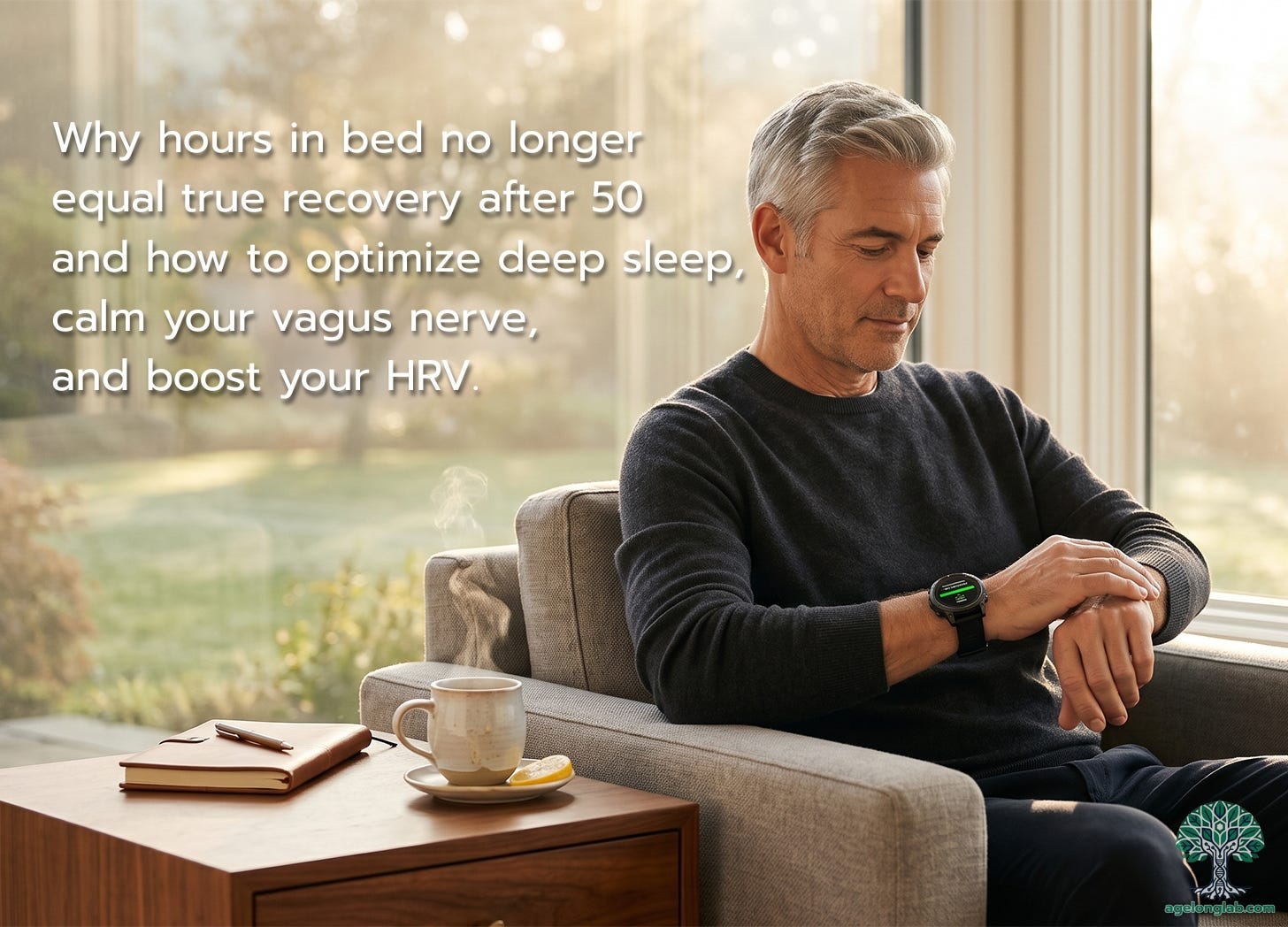
In our 50s, many of us encounter a frustrating phenomenon:
You spend 8 hours in bed, but you still wake up feeling sluggish, brain-fogged, and unrefreshed.
The truth? Quantity of sleep does not equal quality of recovery.
As we age, our Autonomic Nervous System (ANS) becomes more sensitive to daily micro-stresses. Combining quality rest with joint-safe exercise routines helps maintain nervous system balance. However, if your night-time recovery is compromised, your body stays locked in a mild “fight-or-flight” state while sleeping, depriving you of restorative slow-wave sleep.
This is where tracking Heart Rate Variability (HRV) becomes a game-changer. HRV is a real-time report card of how well your body relaxes and recovers overnight.
Here is the AgeLong Lab Restorative Sleep & HRV Protocol built specifically for the 50+ generation.
1. Protect Your Evening HRV (The 3-Hour Buffer)
Your heart shouldn’t be working hard while you sleep. Eating heavy meals or late-night snacks forces your digestive system to work all night, keeping your heart rate elevated and tanking your HRV.
The Protocol: Finish your last meal at least 3 hours before bed.
The Result: Your body switches from digestion mode to deep cellular repair early in the sleep cycle, dramatically boosting morning readiness.
2. Anchor Your Circadian Rhythm with Morning Light
Quality sleep tonight actually starts the moment you wake up this morning.
View Early Natural Sunlight: Spend 10–15 minutes outside in natural sunlight within an hour of waking. Research on circadian rhythm alignment and light exposure shows that morning light sets your internal master clock, boosting daytime alertness and triggering night-time melatonin production.
Dim Artificial Blue Light: Lower indoor lights and switch screens to dark mode 2 hours before bed to signal your brain that it’s safe to power down.
3. Vagus Nerve Activation Before Bed
To transition smoothly into deep sleep, you must deliberately stimulate the Vagus Nerve—the main highway of your parasympathetic (”rest and digest”) nervous system.
Box Breathing / 4-7-8 Breathing: Spend 3–5 minutes doing long, slow exhalations (e.g., inhale for 4 seconds, hold for 7, exhale for 8). Clinical studies on vagus nerve stimulation and parasympathetic recovery confirm that extended exhalations instantly lower heart rate and reduce stress hormones.
Support Systemic Repair: Pairing evening relaxation with anti-inflammatory lifestyle habits ensures your tissues recover rapidly overnight.
⌚ How to Use Your Smartwatch Without Stress
If your smartwatch shows a low HRV score in the morning, don’t panic.
At AgeLong Lab, we use technology as a mirror, not a taskmaster. A lower HRV score is simply your body saying: “Hey, today is a good day for a light walk and a clean Whole-Food meal, not an intense workout.”
💡 The 50+ Practical Takeaway
Stop eating 3 hours before bed to let your heart rest overnight.
Get morning sunlight to set your sleep clock naturally.
Use slow exhalations before sleeping to calm your nervous system.
“Sleep is the ultimate non-pharmacological performance enhancer. Optimize your night, and your days will take care of themselves.”
To your deep rest and daily vitality,
Dejtana
50+ Practitioner & Founder of AgeLong Lab